"Did you ever wake up to find a day that broke up your mind?
Destroyed your notion of circular time?"

Questions About Living Abroad?
You can search almost everywhere online - across the social media spectrum, through blogs, and on video platforms like YouTube, Rumble, Odysee, and Vimeo, looking for information about moving abroad. There are plenty of validated sources available. But how do you know which one is more valid than the other? How do you reach a reality consensus? That's easy... you would just read and watch the thousands of vlogs, blogs, and expat comments - assimilate and analyze it all - and when you are done, you can draw your own conclusion.
Huh?
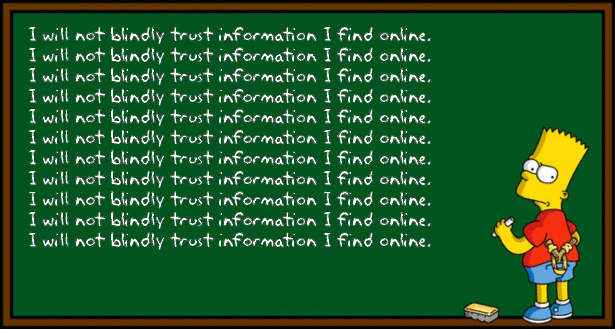
In an era where deepfakes are convincing and AI can write a sonnet in seconds, your "digital intuition" needs a regular software update. Staying sharp online isn't about being cynical; it's about being a bit of a detective.
First know that AI has permeated the entire computing scene with information it gleans from maybe all of the same sources above. In other words, AI can summarize it all much quicker than some guy named Connor drinking Cognac in Climax, Michigan. But it's clearly known that AI "hallucinates" (confabulations). AI models are trained on a dataset comprising biased or unrepresentative data and may confabulate patterns or features that reflect these biases. In the early days of computer programing, programmers coined the phrase"Garbage in, Garbage out" (GIGO) which is a concept that means the quality of a system's output is determined by the quality of its input. If you provide poor, inaccurate, or flawed data (garbage), the resulting output will also be flawed or useless, regardless of how accurate the system or program is. Today, it's more than just a rhetorical programmer's proverb. It's true! Recent estimates put AI at only 85% accuracy.
I Found it on the Internet!
A blog post I originally published in Jan 2013 and updated: "Almost on a daily basis, I will visit my regular chosen blog sites and online forums and sometimes I will chip in my two-peso's worth. Occasionally I will jump in deep when I come across information or comments which are presented as potentially misleading or even totally inaccurate. There are times when I read answers that are published with apparent disregard for accuracy and facts, offered without a hint of any due diligence. Over time, I have witnessed some serious misrepresentations.
There is a common denominator in many vlogs, blogs, and forums that is consistent and evident; There are those content creators who love to write or publish, and they do their research. Some will base content on their own validated experiences. In a nutshell, the more well-established the writer is, the more credibility they possess. But even among some of the best posts, statistics can become stale and even inaccurate. And then they can totally misrepresent, misleading viewers and readers."
"My biggest beef has always been with Facebook keyboard warriors - many times the information they spew can be downright bogus, bordering on negligence. I'm not speaking about the folks that write about their personal accounts of day-to-day activities and experiences, nor am I picking on individuals who might express their opinions about matters out of their control. There are very few well-moderated expat forums originating in the Philippines. When it comes to visual content creation, there are some good knowledgeable and talented Vloggers, and then there is AI. When it comes to expat Bloggers in the Philippines, there aren't many left. Even so, some garbage still makes it through!" (end of original post)
The Plural of Anecdotes is Not Data.
While over thirteen years have passed since I penned that post, my point is even more valid today. Curious readers/info seekers have no idea of any comment author's credibility and can be misled so easily. It's become quite common (especially in the Philippines) for someone to launch a YouTube channel within days of stepping off the airplane! While they might be entertaining, these individuals are unknowledgeable and should not be considered as a viable source of information.
The "Blue Check" Trap: On platforms like X (formerly Twitter), Facebook, and Instagram, a checkmark now often means someone paid for it, not that they are a verified expert or public figure. Other platforms using blue verification marks include TikTok, LinkedIn, and YouTube, and that blue mark validates nothing!
Here is a Quick-Start Guide to Verifying the Digital World.
Providing guidance to unknowing persons using unfounded information based on misconceptions or ignorance is dishonest. Relying on that advice is foolish! Take any cultural advice from an expat who recently got off the plane and started a YouTube channel, well... YOU would be that aforementioned fool. So where should one turn for sound advice and guidance? Now that's a great question!
Instead of listening to inexperienced sources, such as a "newbie" YouTuber or keyboard warriors, here are some reliable ways to get the best advice:
Seek out seasoned expats: Look for "Boots on the Ground" sources who have lived in the country for years who have a deep, practical understanding of local customs and culture. Their firsthand experience is invaluable. There area a lot of "Snake Oil " salesmen online today and one should always start from a place of skepticsm.
Check official sources: When it comes to "official information," there is no substitute for official government websites and embassy pages. These sources provide the most accurate and up-to-date facts on visas, residency, and regulations. And always double-check official Philippines sources.
Be wary of AI-generated advice: While AI can provide good information, it is not immune to inaccuracies. AI-generated content can be based on unreliable sources and may contain misleading facts. As the saying goes, "garbage in, garbage out"—so should one always double-check AI-generated responses, especially when it comes to making life-changing decisions.
Source & Metadata Scrutiny: Before you share that "breaking news" or buy in on the idea that life is just better here, check the origin.
URL Sleuthing: Watch out for "typosquatting" (e.g., the ndp.com instead of theguardian.com). Check if the site is a known satire outlet or a "pink slime" type sites (AI generated information).
Reverse Image Search: Right-click an image and search it on Google or TinEye. This helps you see if a "new" photo is actually an old one being used out of context.
(When an AI assistant posts a footnote disclaimer like this: "Alfred can make mistakes. Double-check replies" ... one should always take heed!
The Emotional Red Flag.
Information which deceives usually targets your Amygdala (the "fight or flight" part of your brain). If the post makes you
Feel... Be wary of...
Instant Outrage/Excitement Headlines designed to make you click before you think.
Extreme Fear Scams or misinformation meant to bypass your logic.
"Too Good To Be True" Highly subjective views or opinions
Social Media Breakdown.
✅ Use it for:
The "Unwritten Rules": Real-world tips on traffic patterns, which grocery stores carry "home" comforts, and how to navigate the local Barangay system.
Niche Communities: Groups like "Expats in the Philippines" or "Digital Nomads Philippines" can provide current info on internet speeds in specific islands like Siargao or Palawan.
Vetting Landlords: You can often find "neighbor reviews" of condo buildings that real estate sites will never tell you about.
❌ Do NOT use it for:
Visa & Legal Advice: Immigration rules change frequently. What worked for a YouTuber in 2023 might get you deported in 2026.
Official Payments: Never pay for "expedited" visas or "eTravel" registration through a link found on social media. Many fake sites mimic government portals to steal credit card info.
Financial Services: A bank that works well for one expat may not satisfy the needs of another. Scams involving "money swaps" or unverified investment schemes are rampant in expat groups.
How to Verify Information in the Philippines.
If you see a post about a new law or a "required" fee, follow the Rule of Three:
Check the Government Domain: Only trust sites ending in gov.ph. The Bureau of Immigration (BI) and the Philippine Retirement Authority (PRA) are your primary sources for immigration related issues.
Verify the "eTravel" Portal: Many travelers are scammed by fake sites asking for money to register their arrival. The official eTravel system is free.
Lateral Search: If a social media post says "The 13a visa requirements have changed," search the exact phrase on a news site like Rappler, PhilStar, or Inquirer. If they aren't reporting it, it’s likely a rumor.
Your "Source of Truth" Directory -
Category Official Source
Visas & Entry Bureau of Immigration (BI)
Retirement Philippine Retirement Authority (PRA)
Work Permits Department of Labor and Employment (DOLE)
Travel Health eTravel Official Portal
Travel Warnings Your pertinent embassy
Final Note on "Influencers": A 2024-2025 survey identified social media influencers as the top spreaders of false information in the Philippines. If a vlog makes moving look effortless and "dirt cheap," they are likely omitting many variables such as their actual standard of living, the costs of health insurance, visa extensions, and "foreigner taxes" in tourist zones. Accurate information can be crucial to the traveler or potential expat in making best decisions. And when it comes to information gathered through AI remember, GIGO still holds true today in the business of information dissemination. All the AI information today is gleaned from many, many sources so, a few poorly-written blogs here, a few more rookie-videos there, and oh... there's that bad apple that spoils the bunch! Are you willing to take that chance?
Check out my "Know Before You Go" posts Part I and Part II.
Disclosure: Author has accumulated over 8 years living in the Philippines, 14 years living in Guam, 42 years of marriage to Filipino culture, and more than 14 years of research and publishing on same . Recognized by Top Blogs for "Best Expat Blog" in 2017.


For Personalized Correspondence & Private Consultations, Join and Support us on PATREON.
Looking For Answers?