Simple Life or an Easy Life?
A Simple Life can mean different things to different people but it doesn't necessarily equate to an Easy Life.
PHILIPPINES
5/15/20269 min read
The Simple Life - Really?
Prior to our permanent arrival in the Philippines, I can recall saying how I was looking forward to retiring here and enjoying the simple life. July 3rd, 2014 marked our first anniversay of living in Samar as full time residents.
Over the course of that first year in Samar, I've was able to observe and reflect, and to view and compare our lifestyle against the standard of living we enjoyed back in the U.S. Two things are for certain. First, we definitely have much less stress and more carefree living. Secondly, we have much less money (or cash flow) than we were used to. But I can affirm that having less money contributes to more carefree living and therefore, less stress.
Since first arriving in the Philippines, I concluded an emperical observation - there is a big difference between living the "Simple Life" and that of just "Simply Living". The ancient Greek philosopher Epicurus taught that an "untroubled life was the paradigm of happiness" and was made possible by "carefully considered choices." He also warned "troubles that followed an extravagent lifestyle outweighed the pleasure of partaking in it." His teachings concluded "what is necessary for happiness, bodily comfort, and life itself should be maintained at minimal cost, while all things beyond what is necessary for these should either be tempered by moderation or completely avoided."
In summary, Epicureanism is an ancient philosophical belief that happiness comes from moderation, simplicity, friendship, and community. In simple terms, it is an approach to life that stresses finding happiness through living simply. In this case, Filipinos then must be Epicureaists.
In this modern era, life is never totally without stress, but when stress levels can be kept at a minimum and properly managed (by exercise, diet, and sufficient income), the negative effects of stress can be easily combated and even nullified.
Stress reduction measures
While I'm not the first person to compare the enjoyment of life here in the Philippines as being equal to the "simple life," I believe that simplicity encompasses a number of different voluntary practices that contribute to the lifestyle. For example, reducing one's possessions or increasing self-sufficiency.
Simple living can easily be characterized as being satisfied by meeting one's needs, and by reducing expectations and desires. One cannot survive without meeting their basic needs, but you can live without wants. While wants and needs are fundamentally different, they can some times be synonomous with each other. Take food for example: it is both a want and a need. On the other hand, a good "Chicago Style" pizza in my neck of the woods would be more than a want, it would be a dream come true! But listen to some expats and all you hear is I "NEED" pizza. Family security is both a want and a need. A fancy sportscar, not so much.
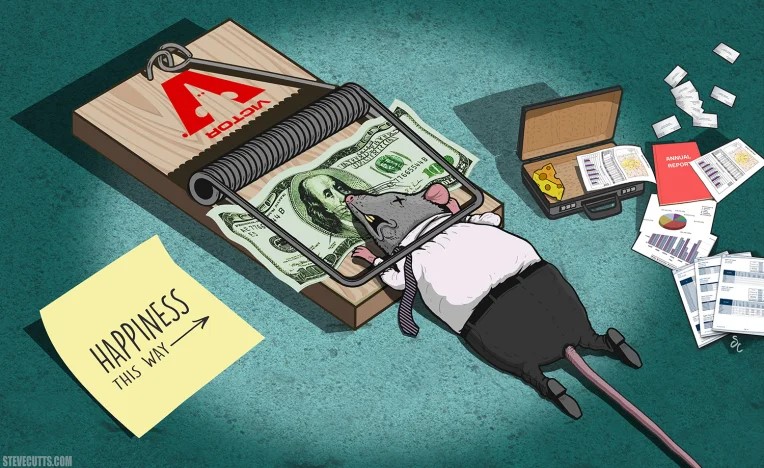
Materialism Is a Trap!
I believe many of the personal finance issues that people face today are a result of stubborn materialism and the inability to recognize and differentiate between their own wants and needs. In short, they live beyond their means. If you want to come to the Philippines to live but need a western lifestyle, well then you will be in conflict. If you are going to live here, then plan on altering your lifestyle. It's that simple!
While a change in lifestyle is required to achieve a more relaxed mode of living anywhere, there are several practices that can lead to a more simple life. Take religion; The Philippines is a predominantly Catholic society and almost the entire country is of some religious faith. That strong faith certainly plays a dominant role in guiding the masses to easily meet many of their daily basic needs. Religious and spiritual traditions encourage simple living. In other parts of the world, more secular approachs to simplicity can be observed. And while it may be religion that has kept this country poor, I won't delve into that here.
Curtailing the consumption of goods is the result of reducing the actual outlay and expenditures on goods or services. As such, the time required to earn that money is also reduced. I can honestly say that much of my free time these days is used to improve my own quality of life. It hasn't been easy but developing a detachment from money has been necessary for me to enjoy a richer and more fulfilling life. While detachment from money is typically easier for men, women tend to have a more difficult time with this. Some people will never grasp this concept and to those people I say, you'd be better off staying right where you are.
One of the immediate benefits of retiring to the Philippines, is the lower cost of living. When relocating from a western society, there is usually a resulting and substantial loss of income but the tradeoff between loss of income and increased purchasing power will be helpful in supporting a standard of living that is comfortable. The key here is that you must have an income! Little or no income is not a good thing.
Simple Life - Is It a Misnomer?
Increasing self-sufficiency is a developed skill that will lead to a greater appreciation and overall enjoyment of life (simply living). This does not necessarily equate to a "simple-life" lifestyle per se, as becoming and sustaining self-sufficiency can require a substantial amount of work. My grandparents and those from the Greatest Generation were a much more self-sufficient society. The culture of having the reliance of family to help out was instrumental in family survival. They also tended to work from before sunup to sundown.
I was reared as a middle-class Baby Boomer in the 50's and 60's. Observing my parents and grandparents, it was clear to me they were fairly self-sufficient, but this was not my idea of a simple life. To me, "simple" was contextually the same as having more stuff that made life easy. So, I chose to grow up as a consumer! I conflated simple with easy, and I was wrong. But now I know that increased self-sufficiency decreases dependency on money and the economy to survive.
This is readily apparent throughout society in the Philippines. Tom Hodgkinson, British writer and socialist, states that the richest countries in the world, in terms of economic output, are the ones where people work the hardest. I do tend to agree with his belief that the key to a free and simple life is to stop consuming and start producing.
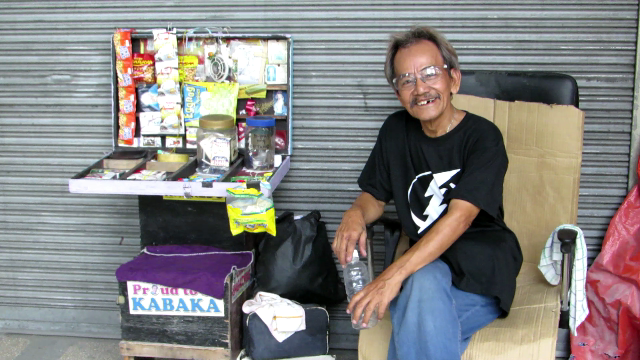
Street vendor in Manila
So as I approach the one year mark living in the Philippines full time, I asked myself the question: whether life here really is simple? When you look around at Filipino families and at how hard family members work to raise and educate their children and what they must do in order to survive each day, it doesn't appear to be a simple life to me. Life here is not simple nor is it easy. It takes work and worry to survive here.
A good portion of the Filipino population here live day-to-day. Fisherman fish early in the morning for today's meals. Women and children carry containers of water daily from public wells to be used for that days bathing, cooking, or washing of clothes. I've seen children fetching water as an early morning chore before heading off to school. Also before school, young children may walk the village streets peddling their father's morning fish catch just to earn a few pesos for the day's rice.
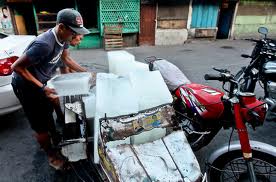
Selling blocks of ice by motorcycle!
In the province, people gather up firewood for cooking their rice and meals. Clothes are washed by hand and hung out to dry - a perpetual daily chore - which becomes even more challenging during the rainy season. Many homes here have no running water and some still have no electricity. In the province, there may be homes without glass-paned windows or screens. Most deal with the heat, humidity, insects, and elements every day. When it rains and the roof leaks, it may not be looked at as a problem so much as it is an opportunity to catch fresh clean water.
People tend to their mostly small gardens to help feed their families or generate a little income. Other families work the rice fields and farmlands. I've watched kids use long sticks and throw their shoes at high hanging fruit in hopes of a reward for their skill and accuracy. Many will climb trees for this food. A good number of people cannot afford any private mode of transportation. Manual labor here takes on an entirely different meaning and, for example, mixing concrete is mostly mixed with shovels by hand on the streetor flat surface.
So you might be thinking as a westerner, I'm not going to live like that so how could all this affect my lifestyle? Things here just don't operate in the greasy-smooth efficient fashion that you may be accustomed to. Quite the contrary. While many things here are accomplished by totally foreign methods, things sometimes seem way more complicated than they need to be - and it downright annoys some expats.
If one has a hard time accepting the status-quo, your "simple life" here can be, well... be filled with complexities. If you are the easy going type and can go with the flow and let things happen how they may, adjustment to life here will be easier for you. Generally speaking, your lifestyle here is what you make of it. Some will adust, some will have difficulties. Some will not be able to make the adjustment.
Even when one becomes acclimated to life here, the system will break down. Know this: any part of any system can and will at times fail. The power grid or the water delivery system, internet and cable TV services, interruptions to food stuff/supply deliveries, and logistics. And when it happens, you'd better have some toughness in you because now the simple life gets tougher. Hopefully, you brought some of that previous turn-of-the-century work ethic with you, because you'll put it to good use.
And then there will be stuff that mother nature throws at you. Throw any bamboo stick in the fan here, and you will likely experience a major inconvenience of some sort. A westerner's life can be easily disrrupted - that will always be a given - and events here can can turn life around 180 degrees. Just how well a foreigner can handle it can be just as tough and complicated as defining the term "simple life."
A Testamonial
When Super Typhoon Haiyan (Yolanda) slammed into the Visayas in November of 2013, the indirect issues we encountered lasted significantly longer than the problems we experienced from the storm itself. However, to the local residents of our village, the only real inconvenience was the lack of electricity and running water. Life was almost normal for them with the exception of having no fans or lights. Did they adapt easily to that? Absolutely! People seemed to just get on with their lives. It was like they didn't even notice any disruption.
We literally found ourselves "camping out" and living like the rest of the population for 28 days. We got lucky and found a generator after the 1st week, but even with the genset, it only restored part-time comfort and limited convenience as we could only run the generator for about 8-9 hours per day. At least we had ice and a return to cold drinks! Who would ever think that having cool water to drink would be a "simple" luxury.
Microwave popcorn is simple - manually making a pot of popped corn, not so much. Having a refrigerator full of food and frozen goods seems simple enough, but having an extended power outage with that freezer full of frozen stuff - not so simple. Inconveniences and disruptions can put significant strains on the simple life, especially if you are unprepared.
So now the big question presents itself like this: Is moving to the Philippines to live really a return to the simple life? The answer is not that simple and can be full of complexities. The "simple life" means focusing on what truly matters by intentionally simplifying one's lifestyle to reduce stress and increase contentment.
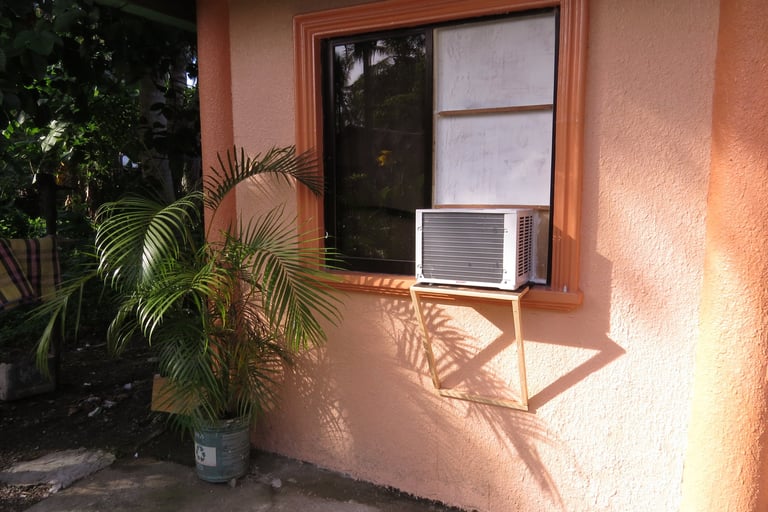
If you imagine the simple life as being able to sit back, relax, and watch TV all day or surf the internet in air conditioned comfort with popcorn and cold beer, or maybe having enough pesos (peso-nality) to throw around so that you can live like royalty, then you may be confusing the "simple life" with the "easy life," which is an entirely different concept of living. I believe that is where all the confusion begins.
A simple window AC unit makes life easier.
And on that topic, if anyone is seeking the easy life here, they will need plenty of money and a sizable income. If the guy with all the money can make the adjustment to live a more relaxed and less materialistic lifestyle, non-dependent of western-world conveniences and luxuries, life can still be good. And with a little advance planning and a sufficient income, one will be able to enjoy the good things in life, when the good things present themselves.
"Some adjust, some don't.
Some will, some won't.
Those who do, do
Those who don't, don't."